
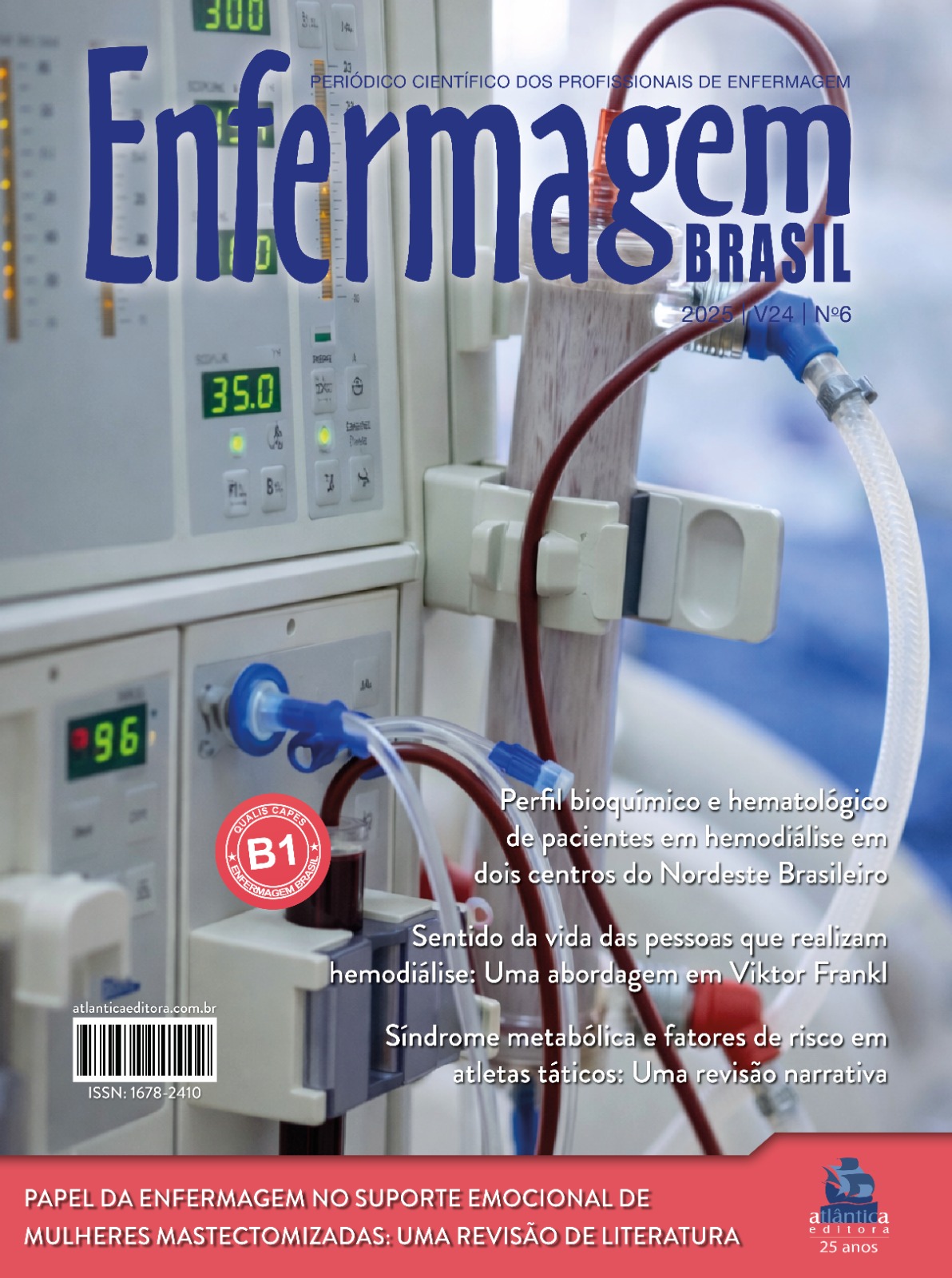
Biochemical and Hematological Profile of Hemodialysis Patients in Two Centers in Northeastern Brazil
DOI:
https://doi.org/10.62827/eb.v24i6.4200Keywords:
Chronic Kidney Disease; Hemodialysis; Biochemical Process; Hematologic Tests; Anemia.Abstract
Introduction: Chronic Kidney Disease is a progressive and irreversible condition characterized by a gradual decline in renal function, which may progress to advanced stages requiring renal replacement therapy. Objective: To characterize the biochemical and hematological profile of patients with chronic kidney disease undergoing hemodialysis in two specialized centers in Northeastern Brazil. Methods: This was an observational, retrospective study with a quantitative approach, conducted through the analysis of electronic medical records of patients undergoing hemodialysis between 2019 and 2023. Individuals aged ≥18 years, of both sexes, were included. The variables analyzed comprised sociodemographic data, etiology of chronic kidney disease, and biochemical and hematological parameters, including pre- and post-hemodialysis urea, creatinine, phosphorus, potassium, calcium, albumin, iron, ferritin, hemoglobin, and hematocrit. Statistical analysis was performed using descriptive statistics and nonparametric tests, considering a significance level of 5%. Results: The sample consisted predominantly of male individuals aged over 60 years. A high frequency of abnormalities was observed in biochemical and hematological parameters, particularly in urea, potassium, phosphorus, iron, hemoglobin, and hematocrit levels. The comparison between pre- and post-hemodialysis laboratory values demonstrated significant reductions in urea and potassium, as well as persistence of alterations related to anemia and mineral metabolism, indicating the complexity of clinical management in these patients. Conclusion: Patients with chronic kidney disease undergoing hemodialysis present significant biochemical and hematological instability, reinforcing the need for systematic monitoring of these parameters. The characterization of the laboratory profile contributes to the planning of individualized interventions and to the improvement of multiprofessional care, especially within the context of nephrology nursing.
References
ALMEIDA, L. L. S. et al. Avaliação metabólica e volêmica no maior intervalo interdialítico de pacientes em hemodiálise com e sem função renal residual. Brazilian Journal of Nephrology, v. 41, n. 4, p. 482-487, 2019. Disponível em: https://www.scielo.br/j/jbn/a/txC895GfyKG4dDchffzhbSn/?format=pdf&lang=pt. Acesso em: 25 nov. 2023.
AGUIAR, L. K. et al. Fatores associados à doença renal crônica: inquérito epidemiológico da Pesquisa Nacional de Saúde. Revista Brasileira de Epidemiologia, v. 44, n. 3, p. 1-15, 2020. Disponível em: https://www.scielo.br/j/rbepid/a/JY5X7GG6mbjfdcX5gcGW6Km/. Acesso em: 25 nov. 2023.
BARBOSA, D. V. et al. Estado nutricional do usuário submetido à hemodiálise. Revista de Enfermagem UFPE, v. 11, n. 9, p. 3454-3460, 2017. Disponível em: https://pesquisa.bvsalud.org/portal/resource/pt/biblio-1032240. Acesso em: 25 nov. 2023.
BRAGATO, A. M. C. et al. A terapia renal substitutiva: relação entre perfil clínico laboratorial, tempo de hemodiálise e sobrevida de idosos com doença renal crônica. Revista Médica de Minas Gerais, v. 26, n. 3, p. 56-60, 2016.
BRASIL. Conselho Nacional de Saúde. Resolução nº 466, de 12 de dezembro de 2012. Diário Oficial da União: seção 1, Brasília, DF, p. 59, 13 jun. 2013. Disponível em: https://bvsms.saude.gov.br/bvs/saudelegis/cns/2013/res0466_12_12_2012.html. Acesso em: 25 nov. 2023.
COELHO, S. R. et al. A influência da HAS na fisiopatogenia da DRC: uma revisão sistemática. Revista de Patologia do Tocantins, v. 6, n. 2, p. 57-60, 2019. Disponível em: https://sistemas.uft.edu.br/periodicos/index.php/patologia/article/view/6950. Acesso em: 25 nov. 2023.
CREWS, D. C.; BELLO, A. K.; SAADI, G. Impacto, acesso e disparidades na doença renal. Brazilian Journal of Nephrology, v. 41, n. 1, p. 1-9, 2019. Disponível em: https://www.scielo.br/j/jbn/a/8JLnj95CnTcJdXv7BtCDJpn/?lang=pt. Acesso em: 25 nov. 2023.
DIEHL, C. A.; SOUZA, M. A.; DOMINGOS, L. E. C. O uso da estatística descritiva na pesquisa em custos: análise do XIV Congresso Brasileiro de Custos. ConTexto, v. 7, n. 12, p. 1-24, 2007. Disponível em: https://seer.ufrgs.br/ConTexto/article/view/11157/6605. Acesso em: 25 nov. 2023.
DREWNOWSKI, B.; KOCH, M. S.; VELLOSA, J. C. R. Análise do perfil dos pacientes atendidos no setor de hemodiálise no período de 2018 a 2021 em uma clínica no sul do Brasil. Revista Eletrônica Acervo Saúde, v. 24, n. 10, p. 1-10, 2024. Disponível em: https://acervomais.com.br/index.php/saude/article/view/16416/8976. Acesso em: 25 nov. 2023.
GOUVEIA, D. S. S. et al. Analysis of economic impact between the modality of renal replacement therapy. Jornal Brasileiro de Nefrologia, v. 39, n. 2, p. 162-171, 2017. Disponível em: https://www.scielo.br/j/jbn/a/fw8XDHCPsT9jZjy6XhrF7mQ/. Acesso em: 25 nov. 2023.
MARINHO, A. W. G. B. et al. Prevalência de doença renal crônica em adultos no Brasil: revisão sistemática da literatura. Cadernos Saúde Coletiva, v. 25, n. 3, p. 379-388, 2017. Disponível em: https://www.scielo.br/j/cadsc/a/jFW54KJnR8hSQX5svKL5Gjn/. Acesso em: 25 nov. 2023.
MARTINS, E. C. V. et al. Tempo de hemodiálise e o estado nutricional em pacientes com doença renal crônica. BRASPEN Journal, v. 32, n. 1, p. 54-57, 2017. Disponível em: https://app.periodikos.com.br/article/10.37111/braspenj.2017.32.1.10. Acesso em: 25 nov. 2023.
MACHIN, D. et al. Sample sizes for clinical, laboratory and epidemiology studies. 4. ed. Chichester: John Wiley & Sons, 2018.
POLIT, D. F.; BECK, C. T. Fundamentos de pesquisa em enfermagem: avaliação de evidências para a prática da enfermagem. 7. ed. Porto Alegre: Artmed, 2011.
SESSO, R. C. et al. Inquérito brasileiro de diálise crônica 2016. Jornal Brasileiro de Nefrologia, v. 39, n. 3, p. 261-266, 2017. Disponível em: https://bjnephrology.org. Acesso em: 25 nov. 2023.
SARAN, R. et al. US Renal Data System 2017 annual data report: epidemiology of kidney disease in the United States. American Journal of Kidney Diseases, v. 71, n. 3, 2018. Disponível em: http://doi.org/10.1053/j.ajkd.2018.01.002. Acesso em: 25 nov. 2023.
SUMIDA, K. et al. Prognostic significance of pre-end-stage renal disease serum alkaline phosphatase for post-end-stage renal disease mortality. Nephrology Dialysis Transplantation, v. 33, n. 2, p. 264-273, 2018. Disponível em: https://pubmed.ncbi.nlm.nih.gov/28064159/. Acesso em: 20 nov. 2023.
VERMA, J. P.; VERMA, P. Use of G*Power software. In: VERMA, J. P.; VERMA, P. Determining sample size and power in research studies. Singapore: Springer, 2020. p. 55-60.
VON ELM, E. et al. The Strengthening the Reporting of Observational Studies in Epidemiology (STROBE) statement: guidelines for reporting observational studies. The Lancet, v. 370, n. 9596, p. 1453-1457, 2007. Disponível em: https://www.thelancet.com/journals/lancet/article/PIIS0140-6736(07)61602-X/fulltext. Acesso em: 20 nov. 2023.
Downloads
Published
Issue
Section
License
Copyright (c) 2026 Graziele Vilar Silva, Thatiana da Fonseca Peixoto, Ellen Goes da Silva, Lavínia Heleno Rufino da Silva, Lindynês Amorim de Almeida, Cicera Áurea Fontes Vilela, Elma Galdino Brandão, Sílvia Renata Gomes Remígio de Sousa (Autor)

This work is licensed under a Creative Commons Attribution 4.0 International License.
Autores que publicam nesta revista concordam com os seguintes termos:
Autores mantém os direitos autorais e concedem à revista o direito de primeira publicação, com o trabalho simultaneamente licenciado sob a Licença Creative Commons Attribution 4.0 que permite o compartilhamento do trabalho com reconhecimento da autoria e publicação inicial nesta revista.
Autores têm autorização para distribuição não-exclusiva da versão do trabalho publicada nesta revista (ex.: publicar em repositório institucional ou como capítulo de livro), com reconhecimento de autoria e publicação inicial nesta revista.