
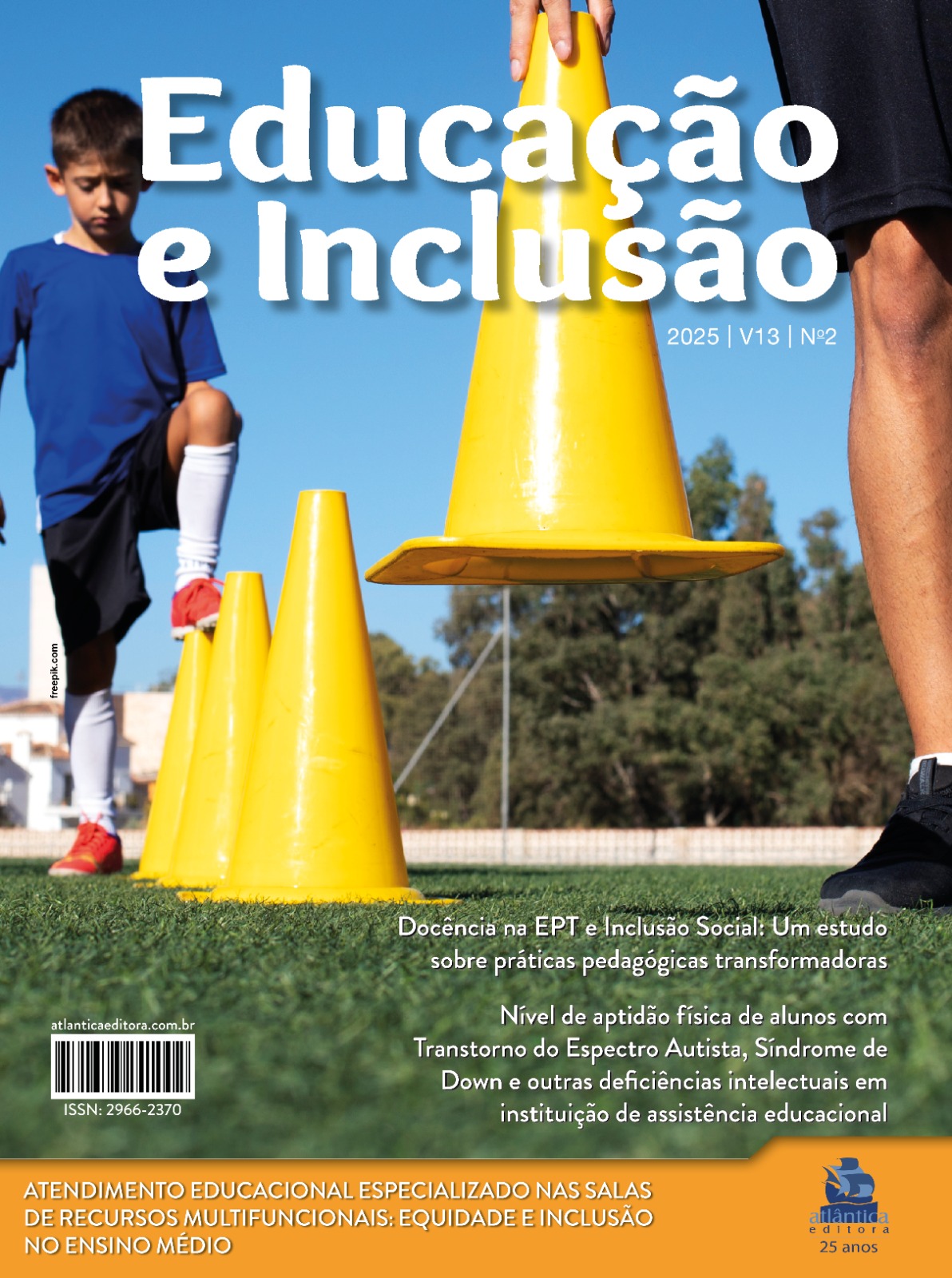
Nível de aptidão física de alunos com Transtorno do Espectro Autista, Síndrome de Down e outras deficiências intelectuais em instituição de assistência educacional
DOI:
https://doi.org/10.62827/ei.v13i2.1007Palabras clave:
Aptidão Física; Autismo; Síndrome de Down; Deficiências Cognitivas.Resumen
Introdução: O Transtorno do Espectro Autista (TEA), Síndrome de Down e deficiências intelectuais representam as principais condições associadas a atrasos no desenvolvimento motor em crianças e adolescentes. Essas condições impactam significativamente aspectos relacionados à coordenação motora, equilíbrio, força, atenção, linguagem, habilidades sociais e desempenho escolar. Objetivo: O objetivo do trabalho foi avaliar e classificar com Transtorno do Espectro Autista, Síndrome de Down e outras deficiências intelectuais de uma instituição de assistência educacional. Métodos: A amostra da pesquisa foi composta por 28 alunos, com idades entre 7 e 25 anos, que foram avaliados por meio da bateria de testes do Projeto Esporte Brasil (PROESP-BR), abrangendo medidas de flexibilidade, força explosiva de membros superiores, agilidade, índice de massa corporal (IMC) e circunferências corporais. Resultados: Os resultados evidenciaram que há um desempenho motor abaixo da média em praticamente todas as variáveis, sendo observadas maiores limitações em flexibilidade e arremesso. Notou-se ainda uma prevalência de sobrepeso, principalmente entre os meninos, com níveis elevados de circunferência abdominal e de pescoço, indicadores que elevam os riscos de desenvolvimento de doenças crônicas. Conclusão: A presente pesquisa evidenciou que a aplicação de uma bateria de testes padronizados como o PROESP-BR, é uma ferramenta útil na avaliação e acompanhamento do desenvolvimento motor de alunos com Transtorno do Espectro Autista (TEA), Síndrome de Down e outras deficiências intelectuais. Os resultados obtidos mostraram que a maioria dos voluntários apresentou níveis abaixo da média esperada em variáveis como flexibilidade, força explosiva e agilidade, indicando comprometimentos no desempenho motor global.
Referencias
Carvalho A dos S, Abdalla PP, Silva NGF da, Garcia Júnior JR, Mantovani AM, Ramos NC. EXERCÍCIO FÍSICO E SEUS BENEFÍCIOS PARA A SAÚDE DAS CRIANÇAS: UMA REVISÃO NARRATIVA. cpaqv [Internet]. 23º de novembro de 2020 [citado 21º de julho de 2025];13(1). Disponível em: https://revista.cpaqv.org/index.php/CPAQV/article/view/642
Projeto Esporte Brasil, PROESP-Br : manual de medidas, testes e avaliações. Ufrgsbr [Internet]. 2021 [citado 21º de julho de 2025]; Disponível em: https://lume.ufrgs.br/handle/10183/217804?show=full
Alvez MB. Efeito de um programa de 16 semanas de exercício físico no perfil psicomotor de crianças e jovens adultos com síndrome de down [Dissertação para Mestrado na Internet]. Porto: Universidade do Porto; 2024 [citado 21 jul 2025]. 24 p. Disponível em: https://hdl.handle.net/10216/164430
Reis HI. Avaliação diferencial e intervenção no espectro do autismo: a complementaridade de pais e profissionais [doctoral thesis na Internet]. [local desconhecido: editor desconhecido]; 2014 [citado 21 jul 2025]. Disponível em: http://hdl.handle.net/1822/35607
Pereira FS, Freitas JFF de. Análise do desempenho motor esportivo de crianças e adolescentes com Transtorno do Espectro Autista. HORIZON [Internet]. 26º de agosto de 2017 [citado 21º de julho de 2025];5(9):100-12. Disponível em: https://ojs.ufgd.edu.br/horizontes/article/view/7644
Mendonça AV, Viana TV, Nascimento KA. A Avaliação do ensino-aprendizagem de pessoas com deficiência intelectual na escola regular em tempos de pandemia. Educ Pesqui [Internet]. 2023 [citado 21 jul 2025];49. Disponível em: https://doi.org/10.1590/s1678-4634202349269037por
Nafiu OO, Burke C, Lee J, Voepel-Lewis T, Malviya S, Tremper KK. Neck Circumference as a Screening Measure for Identifying Children With High Body Mass Index. PEDIATRICS [Internet]. 5 jul 2010 [citado 21 jul 2025];126(2):e306-e310. Disponível em: https://doi.org/10.1542/peds.2010-0242
Ben-Noun LL, Sohar E, Laor A. Neck Circumference as a Simple Screening Measure for Identifying Overweight and Obese Patients. Obes Res [Internet]. Ago 2001 [citado 21 jul 2025];9(8):470-7. Disponível em: https://doi.org/10.1038/oby.2001.61
Descargas
Publicado
Número
Sección
Licencia
Derechos de autor 2025 Carlos Alberto Nascimento, Dilmar Pinto Guedes Jr, Isabel Cristina Possati, Lucca Fazan, Rodrigo Pereira da Silva (Autor)

Esta obra está bajo una licencia internacional Creative Commons Atribución 4.0.
Autores que publicam nesta revista concordam com os seguintes termos:
Autores mantém os direitos autorais e concedem à revista o direito de primeira publicação, com o trabalho simultaneamente licenciado sob a Licença Creative Commons Attribution 4.0 que permite o compartilhamento do trabalho com reconhecimento da autoria e publicação inicial nesta revista.
Autores têm autorização para distribuição não-exclusiva da versão do trabalho publicada nesta revista (ex.: publicar em repositório institucional ou como capítulo de livro), com reconhecimento de autoria e publicação inicial nesta revista.